

BIG QUESTIONS
Do you know what makes your numbers go up?
A lot of marketers (and CFOs) see paid search, PPC, or paid social driving traffic and decide that their brand must be more of a “nice to have.” An easy, yet very expensive mistake.
Because in today’s marketing environment, the channels getting credit are often not the channels doing the heavy lifting. Nielsen found that a 1-point gain in brand awareness or consideration drives a 1% lift in sales, and that upper-funnel brand metrics had a strong 0.73 correlation with marketing efficiency. In short, marketing channels tend to work MUCH better when people already know your name, trust you, and have a positive association with you. Clicks are cheaper when there’s confidence and trust.
Performance marketing merely captures the intent that already exists. But it’s brand marketing that creates that intent in the first place. LinkedIn’s B2B Institute found marketing works best when brand and activation work together, with an optimal split around 46% brand / 54% activation. Not 100% click-chasing. (Again, that’s B2B.) So yeah, sure, watch those clicks with your Sherlock Holmes-sized magnifying glass. Just don’t starve the brand quietly feeding those clicks in the background.
DESIGN WE ❤️
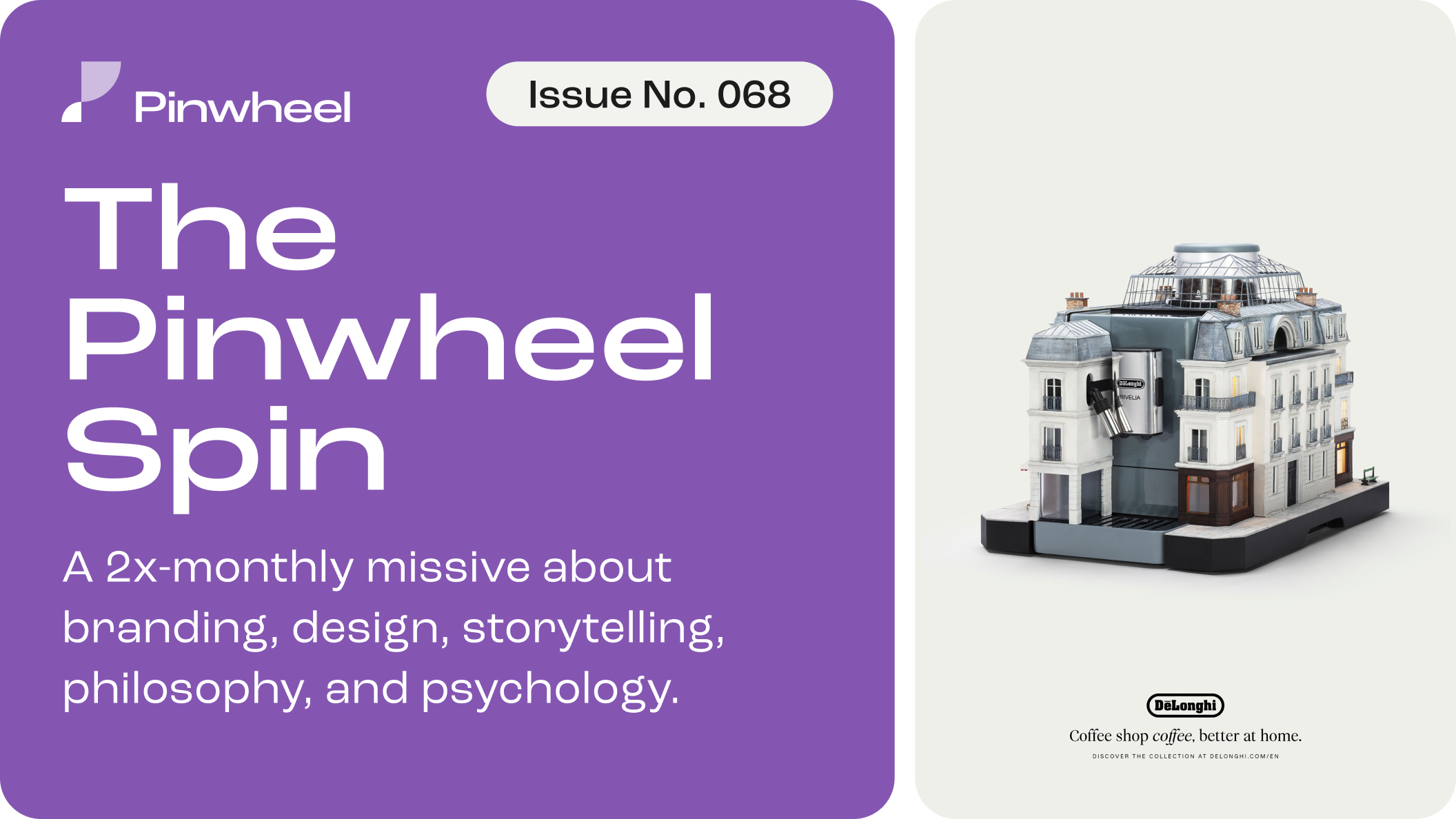
De’Longhi’s The World’s Smallest Coffee Shop campaign

If you’re a fan of espresso, Wes Anderson films, and miniature models, you’re gonna love this campaign by well-known Italian coffee maker brand De’Longhi. Creative agency Lola Madrid partnered with De’Longhi and Wes Anderson’s model maker Simon Weisse to create The World’s Smallest Coffee Shop campaign. Weisse and his team meticulously created five miniature coffee shops inspired by coffee shops in Berlin, Copenhagen, Milan, Paris, and Tokyo that wrapped seamlessly around various De’Longhi espresso machines. The message of the campaign is that having a De’Longhi espresso machine at your home is akin to being in a real coffee shop.
BEEP BOOP

Content’s golden hour: Anthropic posted a $300,000+ job for a Head of Narrative. Plaid acquired its newsletter business (This Week in Fintech). OpenAI spent “low hundreds of millions” on a popular tech industry talk show (TBPN). Hop on the brandwagon, folks. We’ll show you how.
Are we all addicts now? A new lawsuit alleges that DraftKings and FanDuel are digital heroin. Yeah, heroin. In 2024, the U.S. Surgeon General called for warning labels on social media, explicitly invoking the tobacco comparison. There are many, many more famous examples of our digital habits being referred to as harmful addictions. Maybe it’s a sign. ?♀️
Informed to death: In 2010, the CEO of Google claimed that humanity was creating as much information as it had generated from the dawn of civilization through 2003 every 48 hours. By September 2025 it was down to 15 hours. So if you’re feeling overwhelmed, well, maybe that’s why.
A bright ray of sadness: Collectively, we’re paying an extra $300 million per day on gas. That’s $350 per household per year. With inflation-adjusted wages stagnant, we’re all getting poorer by the day. ?
Speaking of cars: It seems the 1970s was the last decade for bold car colors, with hues like Plum Crazy Purple, Lemon Twist, and Hugger Orange. Some might say this was a sign of a society with more appetite for play, swagger, novelty, and visible individuality. A car was not just transport or an asset. It was theater. So… what happened? ?
WORD TO THE WISE
“After 20 years of writing for Nike, Old Spice, Powerade, etc. at Wieden+Kennedy, I can tell you the biggest misconception creatives have about headlines: They think it’s about being clever. It’s not.
A great headline is just an interesting thought, said like a human.”
– Jason Bagley, founder, The Audacious School of Astonishing Pursuits
BECAUSE WE CARE
The Zero-Click Crisis: Try this
In our first Weather Report, we covered how AI is reshaping how buyers find and trust information. Search traffic is declining as AI answers replace clicks, while confidence in those answers is eroding. Marketers are still educating buyers, but losing visibility into who’s learning – and control over how decisions get made.
So what do you actually do about it? Start by auditing your content library. Identify where AI is citing you, then double down on what LLMs prefer: FAQs, comparison tables, expert Q&As. You may not get the click, but you can still shape the answer.
We’ve got more info on the Zero-Click Crisis, and what to do about it, in our free report.
ICEBREAKER
What would you fear most about going to space: the danger, the isolation, the physical and logistical challenges, or the distance from everything and everyone you love?
Matt: No matter how smart they all are, I’d have a hard time trusting my safety to a large group, where any one mistake could kill me.
Melissa: I think you will see a theme from those of us who watched the Challenger explode… but that is a lot of flames next to a lot of flammable materials!
Sarah: Zero fear! Right through sixth grade I was dead-set on becoming an astronaut, dragging my parents to the Kennedy Space Center and begging Hamilton Standard for help with a spacesuit project.
Kim: I’d probably feel nervous during the initial launch – the g-force is INTENSE – but after that, it would be so fun!
Kevin: If I’m being honest, it’s the fact that I get seasick on a little boat. It’s miserable. I can’t imagine how crappy I’d feel in space. ;)
Todd: I could take the immense g-force, risk of instant death, and soul-sucking distance from my home planet. It’s their space toilet that gives me the willies.
Jenn: Seeing the horrific Challenger explosion as a teen definitely killed the “space is fun” vibe. I’m still not sold on prioritizing Mars over Earth, though long-term it’s probably necessary.
Laura: Reentry even though that’s irrational because there are far more failures on launch.
John: I get motion sickness. Turbulence on a jetliner makes me queasy, so I can only imagine how incapacitated I’d be floating and spinning in the great void of space.
Jason: Is it strange that I would worry about what I would eat?
FALLACIES, PARADOXES & THEORIES…OH MY
The McNamara fallacy, and why an obsession with data is wrongheaded
The McNamara fallacy is the habit of making decisions based only on what’s easily measurable, while ignoring factors that are harder to quantify. Coined by social scientist Daniel Yankelovich, it’s named after U.S. Secretary of Defense Robert McNamara (who served 1961–1968), who famously used enemy body counts to prove the “amazing success” we had in the Vietnam War that we lost very, very badly.
What McNamara couldn’t count was the enemy’s conviction, their citizens’ loyalty, and whether rural Vietnamese actually backed the South. Yet it’s these feelings and allegiances that ultimately determined the war.
Not unlike brand metrics: Leaders fixate on clicks and conversions because they tie easily to pipeline. But they miss what matters more: Are you known, trusted, liked, remembered? It’s hard-to-measure sentiments like these that make your performance marketing actually perform.
When leaders cut brand spend because the metrics are messy in order to fund more clean, “measurable” channels, they end up reinforcing the front line while starving the entire supply chain keeping it alive.


