

BIG QUESTIONS
Why is it so hard for companies to stand out?
It’s Branding 101: To get noticed by customers, you must differentiate from the herd. Just find a sharp point of contrast that customers will love, claim it, and organize everything around it: What you offer, how you talk, how you show up, etc. Easy, right?
Uhh, no. While many companies know this in theory, they still get pulled into the tractor beam of indistinguishability. Why? It’s because being different creates tension, and the hierarchy that powers organizations is structurally designed to resist that tension. Hierarchies are neat little machines purpose-built to reduce uncertainty. They say “take risks,” but pay for “don’t break things.” Variances are eliminated. Standards are enforced. Decisions are safe, predictable, and utterly beige. It’s just what they do.
So how do companies climb out of the swamp of sameness? Sideline the hierarchy: 1) Reduce committee-based decision-making, 2) consolidate responsibility with certain individuals, and 3) protect those individuals long enough for their “different” ideas to prove out. Conformity is the default state of any system that optimizes for internal safety. So if you really want to zag when others zig, design the system to optimize for taking risks. We dare you.
TOOL JOY
Pinyahta: Peer reviews for marketing leaders

Ever start a new marketing gig and feel like you were set up to fail? It’s no wonder the average CMO tenure is 22 months. Launching soon, Pinyahta is a new platform that offers a sneak peek into what really goes on behind closed doors – before you take the job. Get insights from fellow marketers about how the C-suite’s support for marketing stacks up, who really owns big brand decisions, the type of budgets and headcount to expect, and the relationship between marketing and sales. Pinyahta for job seekers is currently in its relaunch phase, but you can join the waitlist now and get one month free.
DESIGN WE ❤️
Design trends to watch in 2026

If you have ambivalent feelings toward general-trends roundups, you’re in good company. They can often feel reductionist and lacking in valuable insights. However, a well-done report can be worth reading, like this one by It’s Nice That. It provides historical context and excellent examples, helping us understand what’s driving current design trends.
Many of us are suffering from acute hyper-techno-digital fatigue, exacerbated by the overly polished AI look, and long for the days when technology was still firmly couched in the real world. Trends are an ever-swinging pendulum of movements and anti-movements. Like history, trends don’t repeat as much as they rhyme.
BEEP BOOP

Your new ON/OFF switch: The onslaught of self-help advice in January is a bit much. But Amanda Goetz’s “Character Theory” of time management hit home. Days are organized by the “role” you play (e.g., “artist,” “athlete,” etc.) so you don’t accidentally stray back into “worker” mode.
This is your brand on LLMs: LLMs may be siphoning off traffic, but your brand is still showing up in LLM responses. Hence, traffic is sorta the wrong metric now. LLMs can generate some clicks, but they’re much better for awareness and brand recall. This data shows how the value of AI search to brands will surpass traditional organic search.
Liquid brilliance: Liquid Death has delivered a masterclass in brand partnerships over the years. The latest? A collab with E.L.F. Cosmetics called “Corpse Paint,” a heavy metal-influenced makeup kit. Freaky.
Social media even gives AI brainrot: What happens if LLMs are fed social media content? In a study, researchers found that they experienced reduced reasoning abilities and degraded memory. They also became more psychopathic. Just like us!!
WORD TO THE WISE
In a scene from Monty Python’s film Life of Brian, the title character stands above a crowd and shouts,
“You’ve got to think for yourselves! You’re all individuals!”
The crowd replies in unison, “Yes, we’re all individuals.”
He sighs and says, “You are all different.”
The crowd chants, “Yes, we’re all different!”
Except one man, who mutters, “I’m not.”
BECAUSE WE CARE
Science Says: Behavioral science makes marketing less guessy
Marketing newsletters (ahem, The Spin) are a tried-and-true way to keep tabs on our industry. But with inboxes and mental bandwidth already at capacity, deciding what’s worth consuming can be a chore. To make life a little easier, we’re spotlighting work that we read and would recommend – starting with Science Says. This weekly newsletter pulls research from psychology and behavioral science and turns it into short, readable insights marketers can actually use. We love it because good marketing combines an understanding of human behavior with a healthy dose of creativity.
What are you reading this week, and what’s an insight you gained from it? Tell us.
ICEBREAKER
When was the last time you took a significant risk?
Sarah: A few years ago I moved 200 miles north (with my trusty old pittie) to a place I’ve dreamed of since I was 12. Best decision ever.
Laura: This may only make sense to Bay Area people, but we bought a new house before selling our old one. Will find out in March if the risk paid off! ?
Melissa: Just recently my daughter asked if she could cut my hair (she has no training). I closed my eyes and said go for it.
Jason: I received a text asking if I wanted to help coach high school basketball. I asked if I could think about it for 24 hours. I said yes, and it has been such a great experience in every way.
Irene: I just flew to Dublin, Ireland for a creative writing program for the next four months.
Todd: Well, I’m planning to take a risk right now with Pinwheel. We’re going to be making some changes that I’m super excited about (but also a little nervous). Stay tuned!
Sharon: I went skydiving a few years ago!
Matt: While quarantined during COVID, my wife and I got online and found a cheap home in a medieval Italian town. Lots of photos and FaceTime walkthroughs later, we bought the house sight unseen.
John: Just over three years ago, I moved with my family from the Bay Area to a small town on the Costa Brava in Catalonia, Spain. I’m still very much in the culture shock stage.
FALLACIES, PARADOXES & THEORIES…OH MY
Confirmation bias in marketing
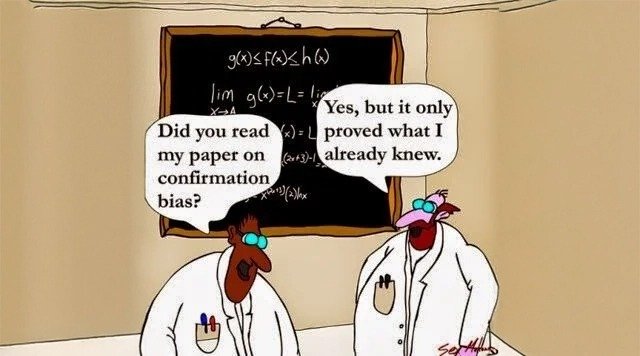
Humans are wired to see what they want to see. It’s easier. It’s comfier. It keeps our worldview intact and our egos unbruised. As Simon & Garfunkel crooned: “A man hears what he wants to hear and disregards the rest.” Usually, confirmation bias is something to fight against. But in marketing, we harness it.
Most people are subconsciously shopping for validation so they buy the stories that confirm what they already believe. Brands that understand this, and are consistent with their storytelling, win. If, on the other hand, your messaging is mushy, off-base, or keeps shifting, people disregard you.
Brands can validate (or confirm) their customers’ worldviews through brand voice, story, visual cues, social proof, consistency, product philosophy, us-vs.-them dynamics, and so on.


