

BIG QUESTIONS
Who owns content in the age of AI?
Machines can generate more text in a minute than the rest of us could possibly handle in a lifetime. But the question of who actually owns the content AI spits out is a bit wobbly. Exhibit A: the recent Bartz v. Anthropic settlement — $1.5 billion (and the largest in copyright history) for allegedly conducting AI training with copyrighted, illegally obtained publications. The takeaway is simple: Creators have value, and content ain’t free.
The landmark ruling also danced around a bigger question we wrestle with often as communications professionals: Should large language models (LLMs) — like Anthropic, ChatGPT, Claude — be permitted to generate content at all — especially when it piggybacks off existing work that someone else owns? Remixing published works that are already out there may be legal (right now), but it turns creativity into an echo chamber — and sometimes lands in strange places.
This is where Pinwheel sits: LLMs can be a helpful productivity partner during the creative process. They can scan for brand voice, dig up research (although fact checking is critical), and help organize thoughts. But what LLMs shouldn’t do is actually create NEW ideas; that should largely be left to humans who actually know what the heck they’re doing. The same goes for knowing how to feed AI the “right” prompts. (And don’t even get us started on AI-generated visuals — that’s a whole other can of worms.)
TOOL JOY
Workaway: A purpose-built home stay platform
Where in the world is Pinwheel’s digital nomad, designer Sharon Kim? Her location changes often, but she tells us that Workaway helps her travel like a local and give back. Workaway is a membership community that connects hosts and “Workawayers” under its philosophy to be a “community based on learning, sharing, and exploring new ways of life.” The platform boasts 50,000 hosts in more than 170 countries. Hosts provide food and accommodation in exchange for about five hours of help a day — plus an allowance. Workawayers pay just $59 a year and can choose from a wide range of experiences, like contributing time to an NGO or sustainable project, pet sitting, or working on a boat. Workawayers can travel solo, with family or a group, and even connect with new travel buddies through the site. The company also plants a tree when a new member joins — with 134,111 trees planted to date.
DESIGN WE ❤️
Dunkin’ Iconic Home campaign
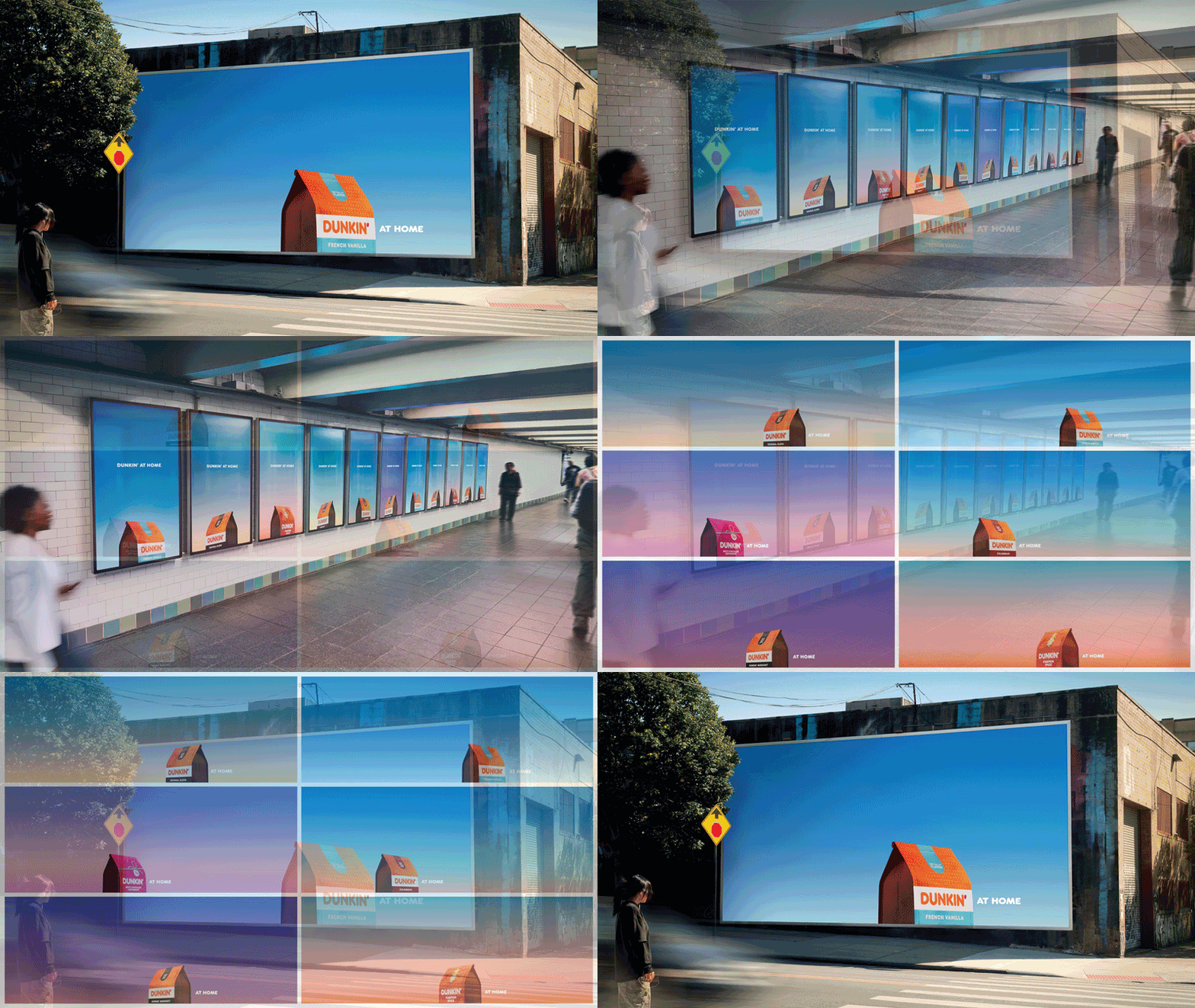
Dunkin’ — the heritage coffee brand many Americans “run on” — aims to reframe how consumers think about their favorite coffee when they’re not on-the-go (and ideally when they’re in the coffee aisle at the grocery store). Enter Dunkin’ Iconic Home, a new minimalist campaign from BBH USA. Designed to be refreshingly simple and cut through the visual noise of a very crowded market. The hero visual turns the Dunkin’ packaging into a home. No extra logos, explainer copy, or busy calls to action. The coffee bag is cropped at just the right angle to resemble a house against a featureless horizon. The house looks so peaceful against a clear, early morning sky — and what says “coffee at home” better than that? Creative Boom sums it up perfectly: “There’s a broader lesson here for creative industries. As advertising evolves to meet fragmented audiences across multiple platforms, the instinct is often to over-engineer campaigns, layering ideas to try to cut through the noise. Sometimes, as Iconic Home shows, cutting through means removing rather than adding.”
BEEP BOOP

Santa’s algorithm is watching: Brands may now sneak into AI search summaries — not just keyword matches — for multi-intent holiday searches. And that means more ways for your product to land in someone’s cart.
AI meets market research, fast forward: Sydney startup Heatseeker just raised pre-seed funding to shake up surveys by creating AI-powered “digital twins” of audiences and running instant experiments. Insight at warp speed, no decades of focus groups required.
AI ≠ punk: A NorCal music venue just outlawed AI-made show flyers, citing an “ick factor.” DIY still rules the pit — and we’re here for it. Rock on. ?
Ford leans on AI — but says creativity stays human: Ford’s CMO says AI is helping with planning, targeting, and even possibly producing imagery via digital twins. But she insists storytelling, authenticity, and “anchoring in what’s real” remain non-negotiable.
Telstra flips the switch on its image: Australia’s Telstra broke out of its comfort zone with “Telstrut” — a campaign with a viral TikTok walk, animated ads, music covers, and big brand storytelling. Result: more buzz, more searches, and more than double the ROI.
WORD TO THE WISE
“If you’re not prepared to be wrong, you’ll never come up with anything original.”
—Ken Robinson, education expert
ICEBREAKER
If you had to choose a walk-up song, what would it be?
Kim: The Bluey theme song comes to mind because it’s upbeat and fun — but if I were really walking up to home plate, it’s gotta be Lose Yourself by Eminem.
Melissa: I think if I was walking up to home plate, I would want Koko Taylor singing I’m a Woman blasting from every speaker.
Irene: Man, I Feel Like a Woman by Shania Twain just captures me at the moment.
Jason: Enter Sandman by Metallica; not sure if it’s a walk-up song, but it was pretty awesome when Mariano Rivera would use it as his entrance song. And I’m not even a Yankees fan.
Laura: My House by Flo Rida; sneakily confident and charmingly upbeat.
Jeremy: Don’t Stop Believin’ by Journey — hope, resilience, and the pursuit of dreams against all odds.
Angela: Freedom by Beyonce — confident, collected, totally cool.
Sarah: Bad Reputation by Joan Jett and the Blackhearts. A little bada$$, and totally rockin’.
John: Yonick Bobonick, a song about yours truly, written by a very old friend. It’s little known outside my little social circle.


