


BIG QUESTIONS
Does your company have an attention-span problem?
Strategic drift. It’s everywhere, but especially at companies fondly referring to themselves as “startups.” They’re often afflicted by a bad case of serial reinvention. Every quarter, a new priority. A new position. A new “north star” proclaimed from on-high. A new marshmallow surprise that scatters your go-to-market motion, blurs your brand signal, and leaves teams scratching their heads about the game they’re supposed to be playing.
Research from McKinsey & Co. shows companies that maintain consistent strategic focus outperform peers by up to 40% in revenue growth over a five-year span. Meanwhile, organizations constantly shifting gears rarely build the trust, traction, or talent alignment needed to scale. The inconsistency is a momentum killer.
Don’t get us wrong, the strategy ideas themselves are often superb. The issue is they’re never given a real shot. Execution barely begins before the next pivot arrives and everyone gets whiplash.
Momentum requires commitment, clarity, and repetition. Strategic drift erodes all three. If you’re wondering why your brilliant strategy isn’t breaking through, the answer may not be to rethink it. It may be to stick with it long enough for the market to notice.
TOOL JOY
Mural: Where strategy stays visible
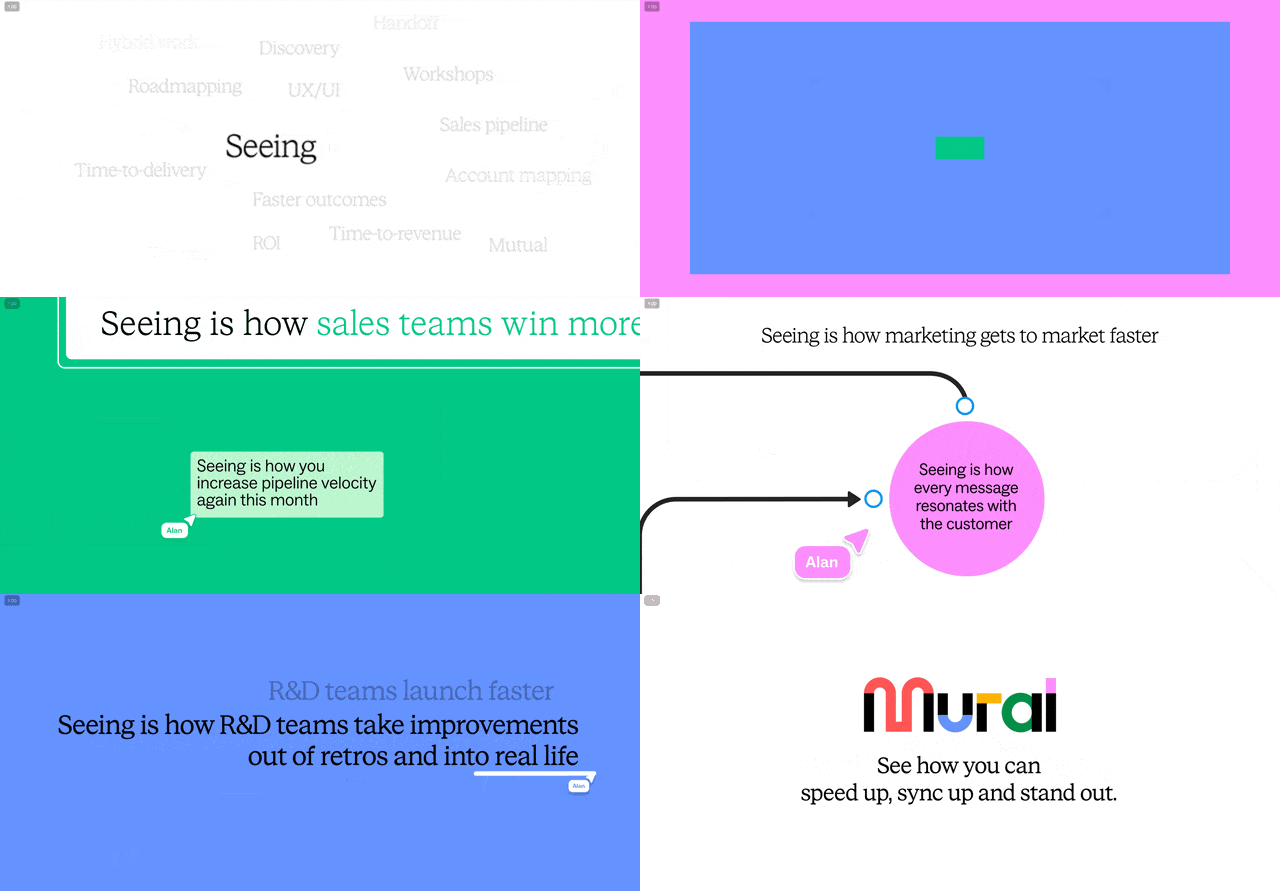
Ever leave a strategy session feeling aligned, only to find out everyone interpreted it differently? Mural is a collaboration app built for these moments. It gives teams a shared virtual canvas to sketch ideas, cluster themes, pin assets, and create roadmaps together (in real time or asynchronously). If things get messy, AI can group themes or summarize boards in seconds. It won’t create alignment for you, but it will make it visible and cohesive.
DESIGN WE ❤️
Bu Deli butter branding by Studio Bland

We are loving the branding of Bu Deli, a plant-based butter alternative. Crafted by Australia-based Studio Bland, the branding of Bu Deli was approached with a specific strategic conviction: that its plant-based credentials should serve as secondary information rather than the primary value prop.
The result starts at the supermarket shelf – Bu Deli reads first simply as butter. Referencing classic French cues, blue foil packaging with contemporary, legible typographic choices wrap a solid block, without the usual plant-based visual gestures, like the use of greens, leaf iconography, and earthy textures. And the beautiful product photography is inspired directly by French surrealist painter, Antoine Vollon. The days of I Can’t Believe it’s not Butter! are over, and not a moment too soon.
BEEP BOOP

The merits of consistency: According to Forrester Research, companies that align “brand promise” with “delivered experience” unlock up to 3.5x revenue growth. Maybe we should all stop pivoting for a half a sec, and give it a go.
Roach-infested blacksites: Swarm Biotactics is working to fit cockroaches with tiny backpacks that carry cameras, microphones, and Doppler radar. Too bad we’re not allies with Germany anymore.
McFishin: McDonald’s, purveyor of fake, ultra-processed “food” scientifically proven to kick your cardiovascular system in the face, is releasing a limited-time-only McNugget Caviar – just in time for Valentine’s Day. YOLO, baby!
Good Bad Bunny: Our first thought when watching Bad Bunny’s Super Bowl halftime show was, “My, that must’ve taken a while to set up.” Here’s a sped-up video of that process. Show design by Yellow Studio.
Like, ya know. Like, ya know. NVIDIA’s new AI voice is out and it’s… wow. I mean just wow.
WORD TO THE WISE
“I much prefer the sharpest criticism of a single intelligent person to the thoughtless approval of the masses.”
– Johannes Kepler (1571–1630), German astronomer, mathematician, and physicist known as the “Father of Physical Astronomy”
BECAUSE WE CARE
Long live the CMO
You may have seen headlines confidently proclaiming the role of CMO is dead. Not so fast. A recent piece in Indie Agency News argues the role isn’t extinct – it evolved into seven “species.”
- Chief Mutiny Officer: Quietly disrupts culture from the inside.
- Chief Missing Officer: Advances marketing under strategic cover.
- Chief Mood Officer: Manages tone, timing, and emotional climate.
- Chief Meaning Officer: Turns complexity into a compelling business narrative.
- Chief Momentum Officer: Moves fast; reframes everything as a pilot.
- Chief Mosaic Officer: Connects silos into one coherent system.
- Chief Moments Officer: Acts precisely when leverage is highest.
The take-away: The CMO doesn’t survive by clinging to an old form – it survives by adapting to its environment. Which CMO “species” are you?
ICEBREAKER
If you were competing in the Winter Olympics, what would be your sport of choice?
Melissa: Speed skating. It just looks… fun… and fast!
Todd: It is a lifelong dream of mine to be a professional luge racer. 100 mph, no brakes, yes please.
Kim: The luge DOES sound fun, but knowing me, I’d probably end up like Jane Wickline’s character in this hilarious SNL sketch.
Sarah: Figure skating, circa the mid-’90s Tonya Harding/Nancy Kerrigan era. BRB, watching The Cutting Edge on repeat and practicing my toe picks until March.
Laura: As a southerner, I’m more comfortable on water skis than snow skis, so the only sport I could even dream of being able to compete in is curling.
Jason: Downhill skiing looks thrilling, but I don’t know if I’d be brave enough to do it. Traveling at 90 mph on snow/ice seems absolutely insane!
John: The ski jump was always a thrill for me to watch. It’s so cool how they make micro adjustments with their skis to control their insanely long jumps.
Irene: Skeleton because sledding at 80 mph… sounds pretty awesome to me.
Emily: All of the Winter Olympics sports seem to require exceptional balance, which I lack, so I think I’d shine as the person who drives the Zamboni.
FALLACIES, PARADOXES & THEORIES…OH MY
AI and the sunk-cost fallacy

So there you are, prompt-writing up a storm. A Leopold Stokowski of the machines, freehanding your way to AI content greatness. You hit “Submit,” and suddenly you’re the proud owner of a nice, shiny 1,500-word draft. The content looks… reasonable. Maybe even good. There are a couple of intriguing nuggets. Excitedly, you start your sculpting work to make it human, emotive, and broadly compelling. Two hours later, you’re not quite sure about it. You find yourself hemmed in by some of the assumptions. Your attempts at untangling have left you with a draft that feels like one of those small river-bound cargo ships – a flat, structureless hull that floats. You could start over, but you’ve got two hours of editing time in it and 20 minutes of prompt writing. You wonder how bad it would be to just submit what you have. This is the sunk-cost fallacy at work in today’s AI-heavy workplace. The sunk-cost fallacy is a cost that cannot be recovered. People tend to continue an endeavor once an investment in money, effort, or time has been made, refusing to succumb to what may be described as “cutting one’s losses.” And that, in the aforementioned context, leads invariably to slop.


