

BIG QUESTIONS
Are you “paying” your prospects and customers enough?
Yep, you read that right: Are you paying prospects and customers? Because even free information – your guides, your blogs, infographics, TV ads, social posts, etc. – requires time and labor to consume. And labor – the cognitive workload it takes to consume your marketing – should be compensated. With what, you ask? How about laughter for starters? Or delight. Epiphanies. Empowerment. Chills. Something! By entertaining people with your marketing, you reward their brains with dopamine (a neurochemical that delivers pleasure) and can even induce a state of flow (total absorption). Your brand storytelling should give them goosebumps, shivers or some other visceral bodily response. In short, to adequately compensate your hard-working audience for their time and effort, your marketing should be neurologically rich such that it stimulates reward pathways, deepens empathy, fuels their imagination, and strengthens their sense of social connection. Done right, it should give your audience the cerebral workout they crave in prediction, emotion, and meaning-making and make them feel absorbed and connected. But hey, a smile in the mind is the very least you can do.
TOOL JOY
Clippy meets AI
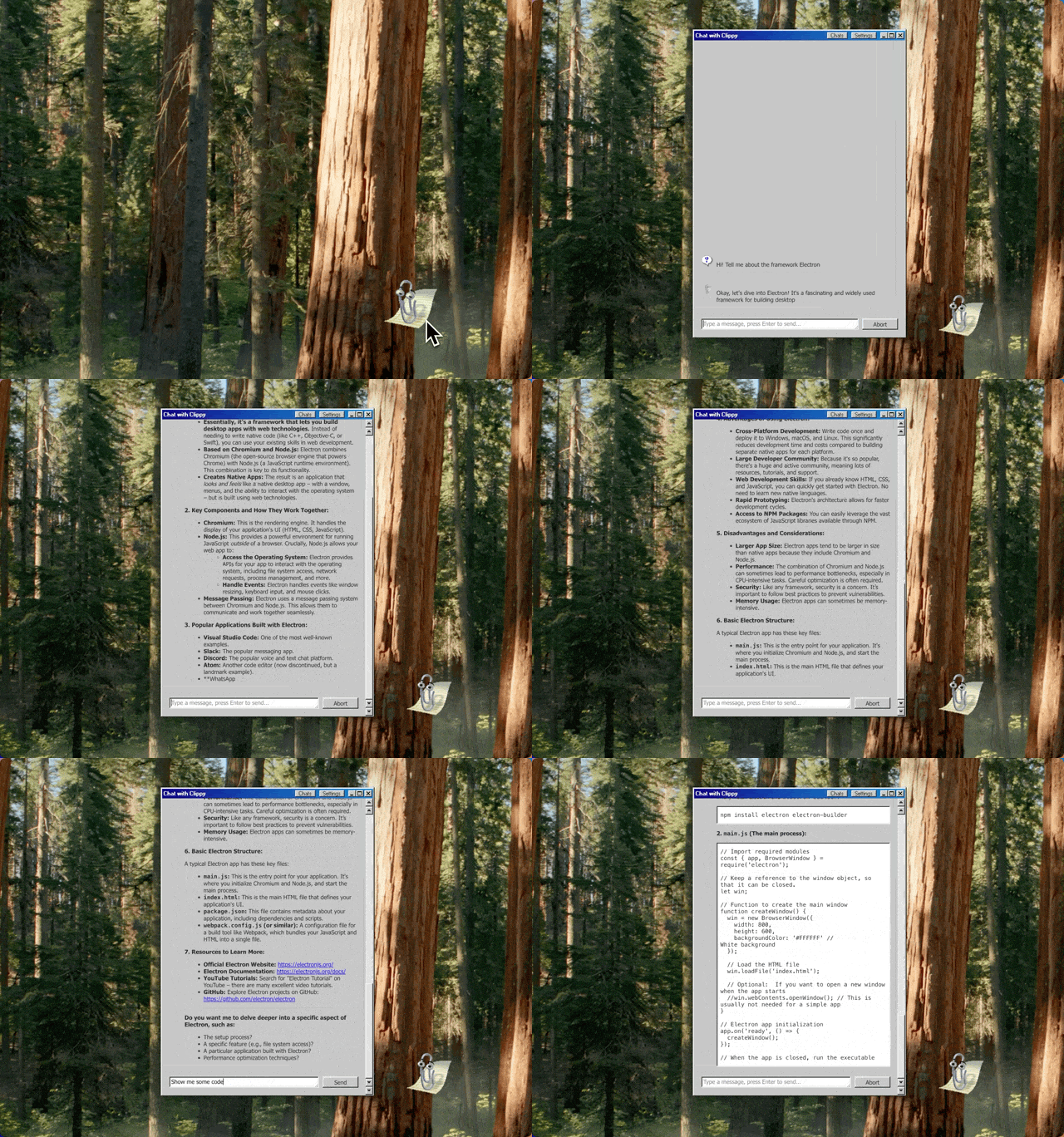
If you’re old enough, you might remember Clippy, the perky, overeager and unintentionally comedic digital writing assistant from Microsoft Office ‘97. If you don’t remember it, well, just know that this early foray into AI was annoying AF. But time has passed now and, just like Robert Downey Jr., it’s being given a shot at redemption. Now you can download Clippy to your desktop and it’ll run a variety of large language models (LLMs) locally on your computer using the same crappy UX you knew and hated from Windows 97. Just open the app and chat away. It’s free and the only network request Clippy makes is to check for updates. Download Clippy for your (Mac or PC) computer here. Side note: Ever wonder what MySpace Tom is up to these days?
DESIGN WE ❤️
Wings Over Water kinetic sculpture

In 2017, the world’s largest kinetic sculpture was unveiled in Houston, TX. Inspired by the city’s diverse population and coastal location, Wings Over Water references the connection between human and avian migration. The wings perpetually undulate via a rotating mechanism—that is, they did undulate, until an historic deep freeze in 2021 took hold over Houston, froze the water pipes, and led to a fatal malfunction of the sculpture. It stands there still, unmoving, a stoic and beautiful testament to the bold risks visionaries and creators take when they manifest their ideas from the abstract and into the physical realm. We can account for every contingency, collaborate seamlessly with all the right people, engineer for every redundancy, grind through that pesky universal law of entropy, and still get blindsided by factors we never could have imagined. The world appears to be changing faster than ever, things seldom go according to plan, but we can at least take solace that we as humans have the capacity to appreciate the deeper beauty of an unmoving kinetic sculpture.
BEEP BOOP

Engine room, we need more power: According to a new Cella 2025 Intelligence Report on in-house creative teams, 47% of marketing leaders feel their creative teams are understaffed to meet the business demand.
All stressed out, nowhere to go: Google searches for the phrase “chronic stress” have hit an all time high. And the average attention span shrank again – this time from 2.5 minutes in 2004 to 47 seconds today (seems generous). The American worker is burnt to a crisp.
Bot vs. Bot: A former sitcom writer (“3rd Rock from the Sun”) discovered that if you pit ChatGPT and Claude against each other like jealous co-workers fighting for praise, they start producing much better prose. Kinda like people.
Who moved all of the cheese? You might’ve noticed a high-pitched primal scream coming from the creative pros in your LinkedIn feed. Their jobs, industry, and entire livelihoods are under threat and many are on the dole. So it’s no big surprise that a new report from Never Not Creative finds that anxiety levels are up among creative professionals from 2022 levels.
SPECIAL FEATURE
Is Bluesky a viable replacement for X?

Hailed as the billionaire-proof platform, Bluesky boasts a refreshingly robust approach to content moderation and user safety, and there are ways to curate your experience such that it’s not a mosh pit of hate and disinfo. Which, 35 million users agree, is nice.
But is it a viable replacement for advertisers? Sort of. Advertisers sensitive to having their messages show up in, let’s say, “mentally unstable environments,” might not mind the smaller user base and nascent ad infrastructure. And for advertisers looking to target specific niche audiences, it might be downright perfect for developing those valuable, authentic connections. It is growing rapidly (~500K users a day), so brands can position themselves as early adopters while gaining a strong foothold in the platform.
WORD TO THE WISE
“If we’re not careful, we’ll look up and realize that we scaled everything except meaning. And the world will feel gray.”
Morgan Short, senior director of content and web strategy @Vendavo
WHAT CLIENTS WANT
Nailing your brand positioning
Smart positioning clears the fog, aligns your team, and gives your brand something to rally around. There are two powerful, complementary ways to sharpen yours:
- Ansoff Matrix: Figure out if you should grow by selling more of the same, launching new products, entering new markets – or all of the above. It’s a classic growth model to clarify how your brand should expand – new markets, new products, or both.
- C-D Map (Centrality-Distinctiveness): A tool that shows how your brand is perceived – are you central and familiar, distinctive and edgy, or somewhere in the messy middle?
Ansoff helps define your internal growth strategy. C-D Maps show how the market mentally files you away. Together, they’re a practical duo for building a brand that knows what it’s doing – and why. If you want help with this, talk to us.
ICEBREAKER
What are you a beginner at these days?
Laura: I started taking cello lessons mid-pandemic, and I am still very much a beginner – and will be for years.
Sarah: I started cold water surfing in the fall of 2022 and am enjoying the learning process.
Melissa: I am trying to learn embroidery. My mom was amazing at it – and I want to be just like her.
Kim: Probably parenting. The thing is, you learn how to care for a kid at a certain age, and then you become a beginner again when they reach a new milestone. It’s a constant learning process – but fun.
Todd: I think we’re all still beginners with AI. I certainly am. And I’ve been both delighted and frustrated by the outputs. On the one hand, it can take a stab at pretty much anything I can imagine. On the other hand, it sometimes gives me a false sense of proficiency and it’s still not great at iterating based on my feedback. So far.
John: Speaking Catalan. I’ve been living in Catalonia for almost three years, and although I’ve made big strides in grasping the language, I still have a looooooooooooooooooooong way to go.
FALLACIES, PARADOXES & THEORIES…OH MY
The Cannae Problem: When your success is a trap

In 216 B.C., Hannibal pulled off a military mic drop known as the Battle of Cannae – surrounding and crushing a much larger Roman army by letting them think they were winning… until they weren’t. It’s a move that’s been studied by strategists for centuries.
In marketing, the Cannae Problem shows up when we mistake short-term wins for lasting dominance. A viral post. A successful sale. A shiny new channel. They feel like victory – until we realize we’ve overextended, burned out the audience, or attracted the wrong one altogether.
The lesson: Know when to step back, regroup, and flank the market with purpose instead of pummelling it with a barrage of tactics. When organizations become victims of their own success – when they mistake “what worked before” for “what will always work” – they create the conditions for catastrophic failure.


